ServicesSide Yards
Concrete Side Yards in Mission Viejo
A finished side yard should carry roof runoff off toward a drain, hold proper clearance below the stucco weep screed and leave working room around gas meters and AC units. Scheduling yours before the rainy season lets you pick the dates instead of reacting to a muddy, puddled path.
A narrow strip that does a lot of work
A side yard is usually three to eight feet of ground between your home and the property line. It carries trash bins, foot traffic, hose lines and most of the roof runoff from that side of the house. Bare dirt or loose gravel there turns soft after rain, washes against the foundation and tracks into the garage. A properly graded slab gives that water a defined path to a drain or the street.
The details matter more here than on an open patio. The finished surface has to sit low enough to keep the required gap below the weep screed at the base of the stucco, yet high enough to drain. On the expansive clay soils common across south Orange County, we also isolate the slab from the foundation so the two can move independently.
With 15+ years in business and a license from the California State License Board (CSLB), we see the same pattern on most side yard calls. The homeowners who get the best result are the ones sorting out drainage and access while it is still a planned project, before it turns into a problem.
What a side yard pour includes
Excavation and compacted base
We dig to depth, remove roots and loose fill, and compact a crushed aggregate base. A consistent base is what keeps a long, narrow slab from settling unevenly along its run.
Slope away from the foundation
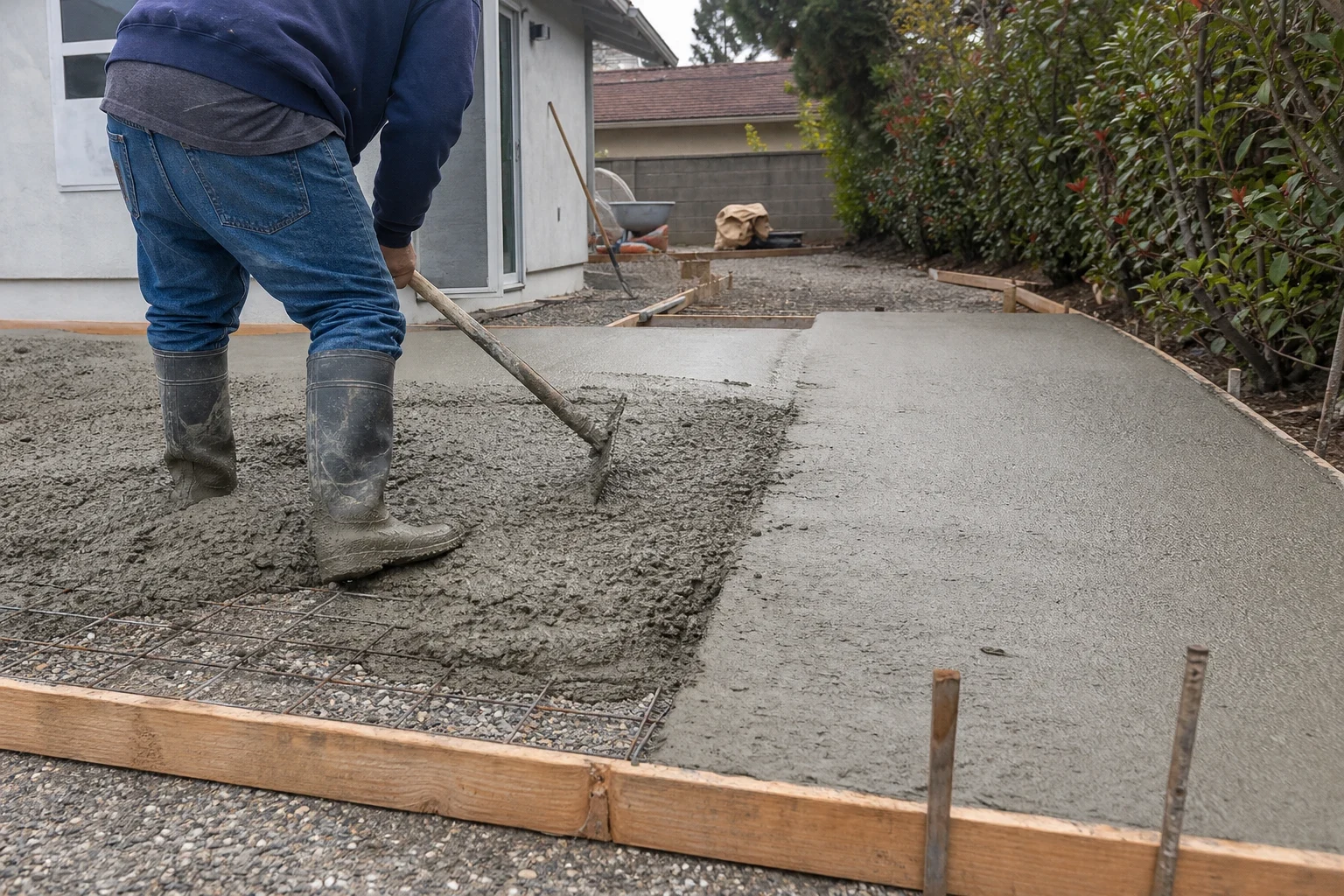
We set forms for a fall of roughly a quarter inch per foot away from the wall or along the run toward a drain. Water leaves the side of your home instead of sitting against it.
Drains and sleeves before the pour
We can set area drains, trench drain sections and PVC sleeves under the slab for future irrigation or low-voltage wiring. Adding them now costs far less than cutting through finished concrete later.
Control and isolation joints
Narrow slabs crack across their width when panels run too long. We tool or saw-cut joints at short intervals to keep panels close to square, and place isolation material where the slab meets the foundation, block walls and equipment pads.
Reinforcement sized to the load
Rebar or wire mesh set on chairs so it sits mid-slab, where it actually does its job. Heavier sections go where bins roll or a condenser pad sits.
Finish and cleanup
A broom finish gives traction in shaded side yards that stay damp. We haul off spoils and leave the gate path clear.
Signs your side yard is ready for concrete
Puddles against the wall
If water sits along the foundation after a storm, the grade runs the wrong way. Repeated soaking stains stucco and keeps the soil next to the footing wet.
Soil above the weep screed
Dirt or mulch touching the stucco traps moisture and gives pests a bridge into the wall. Lowering the grade and paving it restores the gap.
Gravel that will not stay put
Rock migrates into planters and under gates, and loaded bins sink into it. Concrete gives wheels a firm, level surface.
Mud in the garage
When the side yard is the main route to the backyard or bins, every wet day brings dirt inside.
Other flatwork on your list
If a patio or full backyard is planned, pouring the side yard in the same project can share setup, base material and concrete delivery. Our Concrete Backyards page covers that larger scope.
How a side yard job runs
- 1
Site walk and measurements
We measure width, length and existing grades, locate downspouts, the gas meter, cleanouts and the AC unit, and work out how material will get through the gate. You get a written line-item estimate that separates removal, base, drains, concrete and finish.
- 2
Layout and forming
We have underground utilities marked, set forms and string lines to confirm slope, then place drains and sleeves. If a permit applies to the work, we pull it.
- 3
Pour day
Most side yards are too narrow for a truck chute, so concrete comes in by pump line or wheelbarrow. The crew places, screeds and floats the slab, cuts joints and applies the finish while the concrete is still workable.
- 4
Curing and walkthrough
Keep foot traffic off for about a day and rolling bins off for about a week while the slab gains strength. We walk the finished work with you, and it is backed by our 1-year warranty.
Where side yard costs come from
A side yard has modest square footage, but labor runs high because every load of base and concrete has to travel through a gate. Our estimates list each part of the job on its own line, so you can see exactly what each piece costs. That makes it easier to budget ahead and choose which extras belong in this project.
- Access and delivery method
- A wide gate and short run allow wheelbarrows. Tight gates or long runs usually call for a concrete pump, which adds its own charge.
- What has to come out
- Gravel, pavers, old concrete and roots all have to be dug out and hauled away before forming.
- Drainage work
- Area drains, trench drains and tying downspouts into a drain line add pipe, fittings and trenching.
- Grade corrections
- When soil sits high against the stucco, we cut it down and export the extra dirt to restore clearance. The more soil, the more hauling.
- Finish choice
- A broom finish is the baseline. Color or a stamped pattern matched to your patio adds material and labor; see our Stamped Concrete page for options.
Side yard concrete questions
Something not covered here? (949) 267-3649
How wide should a concrete side yard be?
Usually as wide as the space allows. Many homeowners run it wall to fence for easy upkeep, while others keep a gravel strip along the fence to absorb some runoff. Three feet is a practical minimum for bins and a wheelbarrow.
Can you pour around my AC unit and gas meter?
Yes. We form around the gas meter with clearance left for access and either pour around the existing condenser pad or set a new pad as part of the layout. Isolation joints keep vibration and movement in the equipment from cracking the surrounding slab.
Will the concrete crack?
Concrete loses a little volume as water leaves the mix, so fine hairline cracks are expected. Control joints give that shrinkage a planned place to go, which is why cracks usually follow the tooled lines rather than running across a panel. A compacted base and properly placed reinforcement limit the settling behind wider cracks.
When is the best time to schedule a side yard?
Late spring through fall is easiest, because dry ground simplifies grading and curing. Booking a few weeks ahead lets you finish before winter rain shows you every low spot in the yard.
Does someone have to stay at the house while you pour?
No, plenty of homeowners head to work as usual. What the crew needs is access: the side gate left open or unlocked, dogs and cats kept indoors, and the driveway clear if the pump truck will park there. We confirm each of those points with you on a call before the pour.
Get your side yard on the calendar
Tell us the width, what is there now and where the water goes when it rains. We will talk through options and set up a site walk so you can budget the work before the wet months.