ServicesConcrete Garage Floors
Concrete Garage Floors in Mission Viejo
We tear out tired garage slabs and pour new ones on a compacted base with steel reinforcement, a vapor barrier and a slope that sheds water toward the door. You get a clear scope and a schedule, so the work happens on your timeline instead of after the floor gives out.
When a New Garage Floor Is the Right Call
A garage slab carries more weight than most concrete around your home. A parked car puts a concentrated load on four small contact patches, and hot tires, dripping oil and road salt from mountain trips all work on the surface. Over decades, the base underneath can settle and the slab can crack, heave or tilt so water pools instead of draining out.
Our work is full replacement: we remove the old slab and pour a new one. We are not a repair company, so we will not sell you patching or crack filling. If your floor is still sound, we will tell you that and suggest when to start budgeting for replacement.
Planning ahead matters here because a garage floor takes your parking space out of service for about a week while the concrete gains strength. Knowing the scope early lets you choose the timing, arrange street parking and clear out storage on your schedule.
What the Work Includes
Demolition and haul-off
We saw-cut the old slab where it meets the driveway apron and footings, break it out and haul the debris away. Cutting a clean line keeps the new pour from bonding unevenly to concrete that stays.
Subgrade and base preparation
We remove soft or organic soil, add crushed aggregate base and compact it in lifts. Much of the soil in this area is expansive clay that swells when wet, and a well-compacted base is what keeps the new slab from moving with it.
Moisture barrier and steel
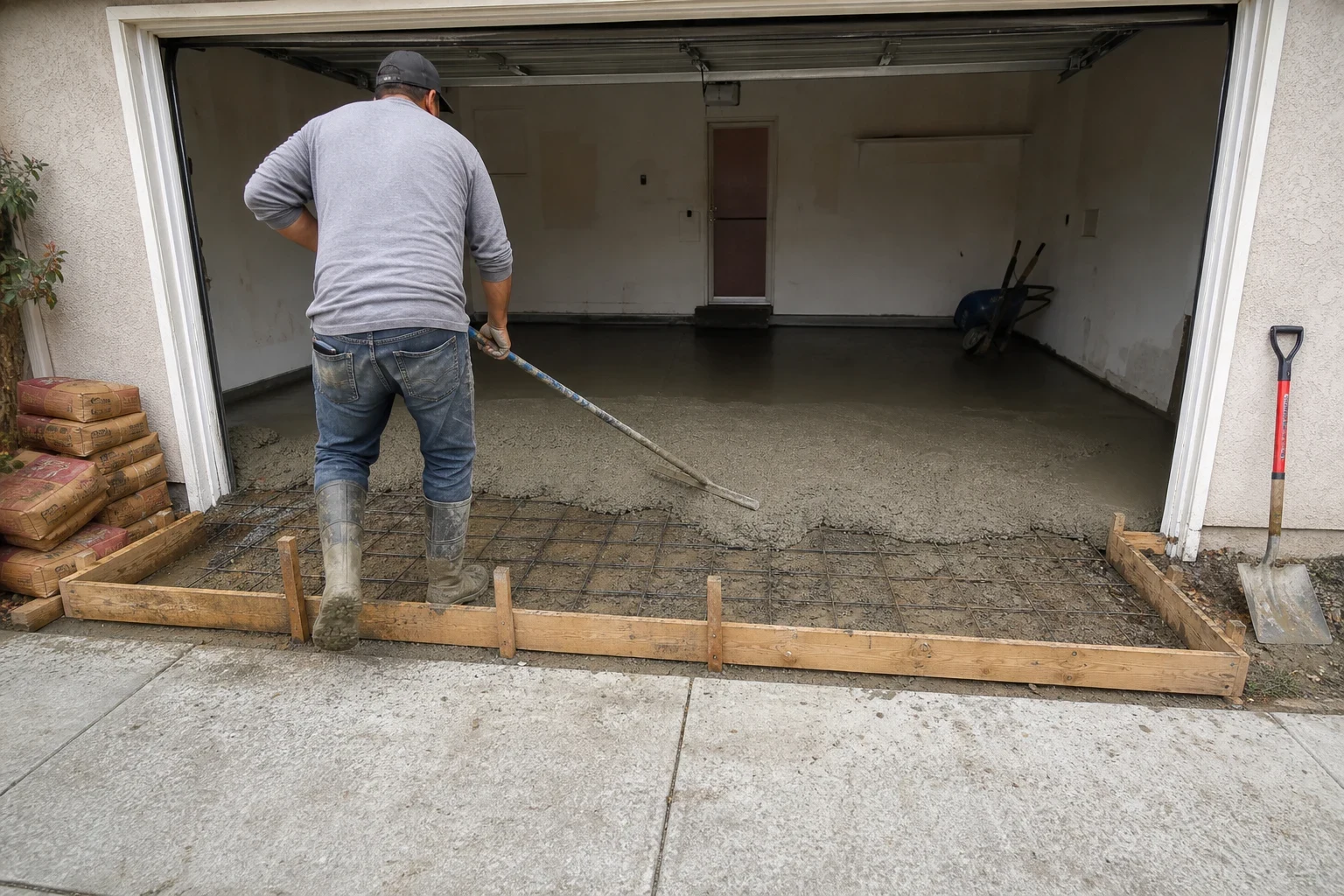
Before any concrete goes in, we lay heavy plastic sheeting over the base to limit how much water vapor from the soil reaches the slab. Rebar or welded wire then sits on chairs at mid-depth, the position where steel does its job of holding cracks tight.
Slope, pour and finish
We set forms for a gentle fall toward the garage door so water from wet cars runs out instead of pooling. The concrete is placed, screeded, floated and given a broom or smooth trowel finish depending on how you use the space.
Control joints and curing
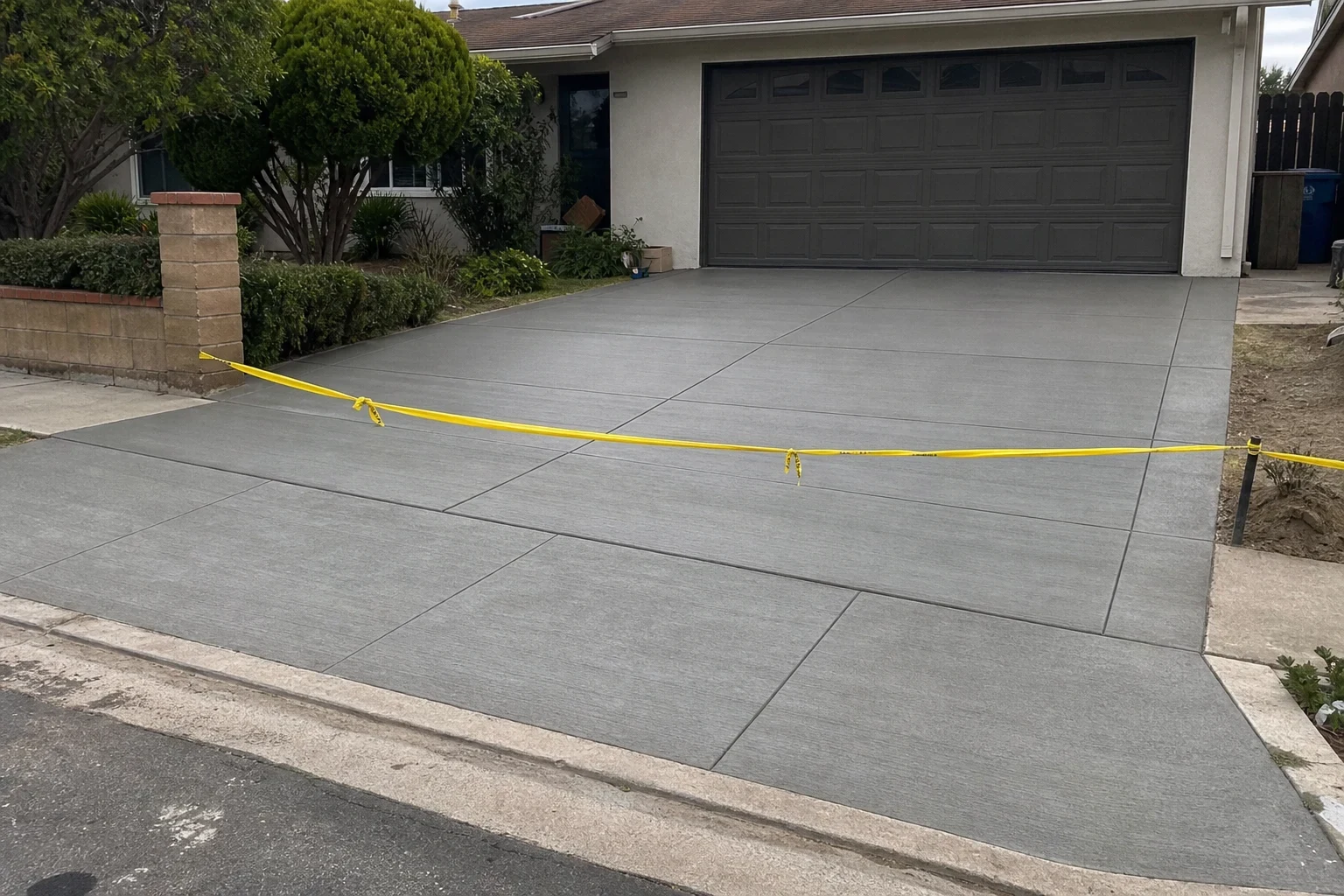
Control joints are saw-cut within hours of the pour so the slab cracks along straight, planned lines rather than at random. We then cure the surface to hold moisture in, which helps the concrete reach its design strength.
Signs Your Garage Floor Is Due for Replacement
Water pools in the middle
If water sits near the back wall or in low spots, the slab has settled or was never sloped correctly. Standing water stains the floor and wicks into anything stored on it.
Cracks with an uneven edge
Thin shrinkage cracks are expected in any slab. If you can feel a lip where one edge has dropped below the other, the soil beneath has shifted, and no surface treatment will correct that.
Spalling and a dusty surface
Flaking, pitted or powdery concrete means the top layer has broken down. It tracks dust into your home and keeps getting worse with every season.
Sinking at the door or apron
A gap or step where the garage floor meets the driveway is a trip hazard and lets water run under the slab, which softens the base further.
Oil-saturated concrete
Years of drips soak deep into the slab. If stains return no matter how you clean them, a new floor is the honest fix before you add a coating or finish the space.
How a Garage Floor Job Runs
- 1
Look at the slab and talk through goals
We check slope, cracking, settlement and how the slab ties into the driveway. We also ask how you use the garage, since a workshop, a home gym and a coating you plan to add later each call for a different finish.
- 2
Written scope and schedule
You get a line-item estimate covering demo, base, reinforcement, thickness and finish. If the city requires a permit for the work, we handle the application so you do not have to.
- 3
Removal and base work
After you clear out the garage, we cut and break up the old slab, haul it off, then grade and compact the base. Forms, the moisture barrier and the steel are all in place before the concrete truck shows up.
- 4
Pour day
We place and finish the concrete, saw-cut the control joints and start curing. We protect walls and the door track and clean up the work area before we leave.
- 5
Cure and return to use
Walking on the new floor is usually fine within a day or two, and parking a car is typically safe after about seven days. Hydration continues inside the slab for close to four weeks, which is why you get a written schedule showing when to park and when a coating can go down.
What Drives the Price of a New Garage Floor
Two things set most of the price: how many square feet we pour and what we find under the old slab. Base condition is only fully visible once the concrete is out, so our estimate spells out how we will handle soft soil if it turns up. That keeps the figure you set aside realistic.
- Floor area and slab depth
- Concrete is ordered by the cubic yard, so a double-bay garage needs roughly twice the material and labor of a single bay. Parking a heavy pickup or setting up stationary shop tools can justify a deeper slab or tighter rebar spacing, and both add to the order.
- Removal of the old slab
- Older slabs that are extra thick, packed with steel or run under the walls need more saw cutting and more trips to haul the broken concrete away.
- What the soil is doing
- Clay that swells or ground that stays damp may have to be excavated and replaced with additional compacted aggregate base. On most garage jobs this is the line that varies the most.
- Access and surface finish
- If a truck cannot back up to the garage, or the only route is a tight side gate, we may need a concrete pump. A hard trowel finish meant for a future coating also takes more labor than a broom finish.
Common Questions About Garage Floor Replacement
Something not covered here? (949) 267-3649
How many days will my garage be out of use?
Most jobs take around a week from start to parking. Removal and base prep run one to two days, the pour takes one day, and the slab then needs several days to gain enough strength for a vehicle. You get the specific dates in writing before work begins.
Can you patch the cracks instead of replacing the floor?
Patching and crack filling are not part of what we do. Our garage floor work is full replacement: we take out the old slab and pour a new one. If your floor still has years left in it, we will say so and help you plan the timing and budget for later.
Will my new floor crack?
Every slab shrinks a little as it cures, so we cut control joints to give that movement a planned place to go. With a compacted base, steel held at mid-depth and a proper cure, any cracking stays as fine lines in those joints rather than breaks running across the floor.
Who stands behind the work?
Our company holds a license from the California State License Board (CSLB), and we have been in business 15+ years pouring concrete around your area. Every garage floor we install is covered by a 1-year warranty.
I want an epoxy coating later. Does that change the pour?
Yes. Let us know up front and we will hard trowel the surface and make sure a moisture barrier goes under the slab, because vapor rising through concrete is one of the main reasons coatings lift. Most coating installers ask for about 28 days of cure time first.
Get Your Garage Floor on the Calendar
Tell us about your slab and how you use the garage. We will walk you through the scope, the cure timeline and what to budget, so you can schedule the work before the floor forces the issue.